World Bible
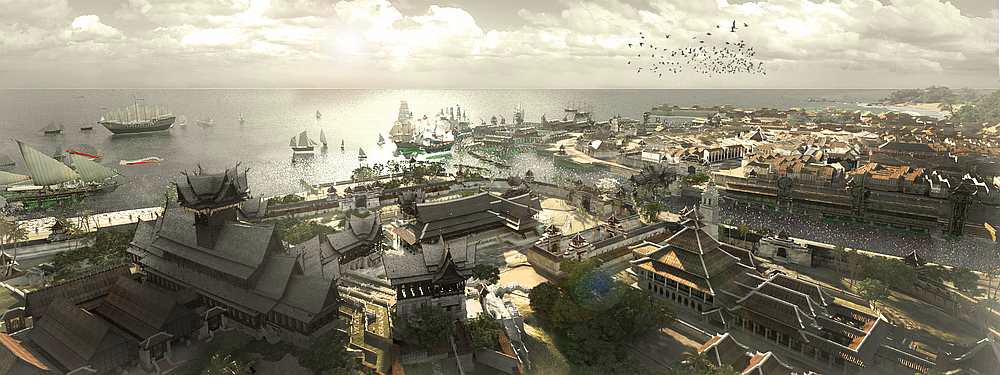 The Port of Malacca — Concept Art by Faizal Rahmat
The Setting: Malacca, c. 1470–1511
The Straits of Malacca are the narrow waterway separating the Malay Peninsula from Sumatra — the only viable sea route between the Indian Ocean and the South China Sea. Every ship carrying spices from the Moluccas, silk from China, textiles from Gujarat, or horses from Arabia must pass through these waters. Whoever controls the Straits controls global trade.
The city of Malacca sits on the western coast of the Malay Peninsula at the narrowest point of this passage. Founded around 1400 by Parameswara, a Srivijayan prince fleeing political collapse, it grew in barely two generations into the largest and wealthiest port in Southeast Asia — possibly the world.
Geography & Urban Structure
The city is divided by the Malacca River. The western bank houses the royal palace complex, the Bendahara’s administrative quarter, and the religious centres. The eastern bank is the commercial zone: warehouses, merchant quarters organised by ethnicity, dockyards, and the sprawling bazaar districts. The harbour itself is a forest of masts — junks, dhows, sampans, and carracks anchored in shifting formations.
Beyond the city walls, the hinterland is dense tropical jungle, intersected by river systems that connect Malacca to inland tin mines and agricultural settlements. Coastal kampungs (villages) and Orang Laut (sea nomad) communities extend the city’s reach along the Straits, acting as pilots, sentinels, and the Sultanate’s informal navy.
Political Structure
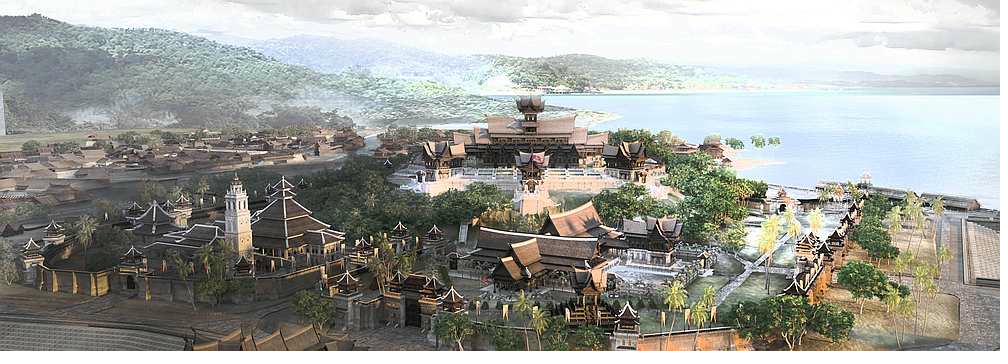 The Royal Palace Complex — Concept Art by Faizal Rahmat
The Sultan
The divine sovereign. His authority is theological and absolute in theory, but in practice constrained by the Bendahara, the merchant guilds, and the balance of ethnic factions within the port. The Sultan’s legitimacy rests on maintaining trade flow and religious authority.
The Bendahara
Chief minister and chief strategist. The Bendahara manages the state’s alliances, legal system, and intelligence apparatus. In the era covered by this franchise, Tun Perak holds this role — the most powerful Bendahara in Malaccan history, whose strategic brilliance holds the Sultanate together through escalating crises.
The Laksamana
Admiral of the fleet and commander of maritime defense. The franchise’s most iconic figure, Hang Tuah, holds this title. The Laksamana is the visible arm of state power — the warrior-diplomat who embodies Malay martial culture.
The Temenggung
Head of law enforcement and internal security. Controls the hulubalang (warrior-administrators) and the deniable intelligence operations that form the gameplay backbone of the franchise.
The Shahbandar
Harbourmaster and trade regulator. Each major merchant community (Chinese, Indian, Arab, Javanese) has a designated Shahbandar who manages disputes, tariffs, and commercial law. The Shahbandar system is a key gameplay and narrative element: it is through trade regulation that foreign powers first subvert Malaccan sovereignty.
Cultural Ecosystem
Malacca’s identity is defined by plurality. The franchise depicts this not as a utopian ideal but as a complex, pragmatic system that requires constant negotiation. Every quarter of the city sounds, smells, and operates differently:
Kampung Keling — The Tamil merchant quarter. Hindu temples, textile warehouses, money-lending houses. The sound of Tamil prayers and haggling over cotton prices.
Kampung Cina — The Chinese quarter. Junk warehouses stacked with porcelain and silk. Tea houses where intelligence is traded alongside goods. The Peranakan community — children of Chinese-Malay intermarriage — bridge both worlds.
Kampung Arab — Arab and Gujarati traders. The religious heart of the Muslim merchant community. Madrasas, Sufi lodges, and the luxury goods trade: perfumes, precious stones, horses.
Kampung Jawa — Javanese and island Southeast Asian communities. Spice traders, shipbuilders, and mercenaries. Connections to the Majapahit empire’s twilight and the rising power of Demak.
The Waterfront — Where all worlds collide. Docks, taverns, gambling houses, smuggling operations. Every language spoken. Every deal made. Every throat cut.
Trade & Economy
Trade is the lifeblood of Malacca and the central mechanic around which the franchise’s world operates. The port handles an extraordinary volume and diversity of goods:
| Origin | Goods |
|---|---|
| China | Silk, porcelain, tea, lacquerware, iron goods |
| India | Cotton textiles, gems, opium, metalwork |
| Arabia | Horses, incense, dates, glassware |
| The Moluccas | Cloves, nutmeg, mace — literally worth more than gold in Europe |
| Malay hinterland | Tin, camphor, tropical hardwoods, birds’ nests |
Control of this trade flow is the franchise’s core dramatic engine. When foreign interests begin to manipulate trade law, bribe Shahbandars, and establish monopolies, they are not merely cheating — they are committing an act of war against Malacca’s sovereignty.
The Malay Martial Tradition
Silat — The overarching martial art encompassing striking, grappling, joint manipulation, and weapons. Multiple regional styles exist, each with philosophical and spiritual dimensions.
The Kerambit — Curved, claw-shaped blade. The franchise’s signature weapon. Reverse-grip, close-quarters, designed for control and lethality. Symbolically tied to the tiger.
The Kris — The asymmetric dagger central to Malay identity. Each kris is unique, often attributed spiritual power (semangat). A kris is not merely a weapon but a marker of status, identity, and metaphysical authority.
The Sumpitan — The blowpipe. Silent ranged weapon associated with jungle warfare and indigenous communities. In the franchise, it serves as the primary stealth weapon.
The Supernatural Landscape
Malacca’s spiritual world is layered: pre-Islamic Malay animism, Hindu-Buddhist cosmology from Srivijaya and Majapahit, Sufi mysticism, and Chinese folk religion coexist. The franchise treats this plurality as both cultural richness and a fault line that can be exploited.
Pontianak — The vengeful spirit of a woman who died in childbirth. Appears as a beautiful woman, reveals its true form in attack. Associated with the scent of frangipani and the sound of a baby crying.
Penanggal — A detached female head that flies through the night with its entrails trailing below. Feeds on the blood of pregnant women and newborns.
Toyol — A child-spirit bound to serve a master, typically sent to steal from enemies. Created through dark ritual by a bomoh.
Orang Bunian — The hidden people. A parallel civilisation of beautiful, invisible beings who live alongside humans in the deep jungle. Sometimes benevolent, sometimes predatory.
Hantu Raya — A powerful master spirit that can be inherited or bound through ritual. Grants its keeper wealth and power at terrible personal cost.
Bomoh — The shaman-healer who mediates between the human and spirit worlds. Can be a protector, a curse-breaker, or a weapon. The bomoh is the franchise’s Van Helsing figure — operating at the boundary of science and belief.
Semangat — The spirit-essence believed to inhabit objects, particularly forged blades. The Keris Taming Sari’s legendary invulnerability is an expression of powerful semangat.
Usage Rule
These elements are available to all franchise creators. In grounded stories (political thrillers, espionage), they exist as belief and rumour. In supernatural stories (horror, fantasy), they manifest directly. The franchise’s only rule: never reduce them to game mechanics or genre furniture. They are expressions of a living spiritual tradition and must be treated with the same respect as the historical elements.